Saint Paul Police: “It just doesn’t seem right”—watching the same gun cases cycle back through the system
About six years ago, officers from the Saint Paul Police Department’s Gang and Gun Unit noticed something troubling. People they charged with gun-related misdemeanors, like possessing a gun without a permit, would cycle through the courts and do their probation or jail time — only to end up committing more gun crimes, often more serious ones. SPPD approached prosecutors in the City Attorney’s Office with an idea: keeping people with guns from ever shooting someone with them.
Listen to this episode of the ONS Podcast ↗️
Like other cities, Saint Paul sees many of those most at risk — disproportionately Black and brown young men — carry firearms for safety. Yet possession alone can trigger a separate harm: a justice-system encounter that can reshape the course of a life.
“The Gang and Gun unit approached us,” supervising prosecutor Tamara “Tammie” Larsen told me, “and said, ‘Hey, it just doesn’t seem right to only have the one option, that we go through the court system.’ So we worked really closely with them to come up with something more than that.” That something is the Gun Diversion Program, Saint Paul’s approach to combating gun violence through accountability and community, not just punishment. “There is a place for punishment,” Tammie said, “but so often, it doesn’t work to create a safer community.”
The Gun Diversion Program, by contrast, works remarkably well. That’s because it incorporates ETHOS, a restorative justice component. Both initiatives were created by the City Attorney’s Office with the leadership and support of City Attorney Lyndsey Olson.
As of a year ago, 21 people had been accepted into the Gun Diversion Program. Six of them didn’t complete it successfully, and five of those people committed new offenses. But among the 15 people who successfully completed the program, only one has committed a new offense. Recidivism among ETHOS participants overall dropped from 32% to only 9%. Gun violence in Saint Paul has been declining dramatically, and this dramatic drop in recidivism is one powerful reason why.
Gun diversion with ETHOS: How it works
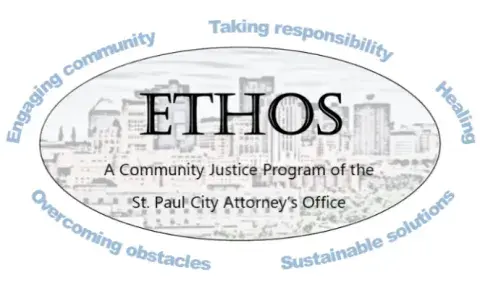
The word ethos, which means the spirit of a community, is also an acronym: Engaging community, Taking responsibility, Healing, Overcoming obstacles, and Sustainable solutions. Those ideas make the Gun Diversion Program work.
“We’re aiming to intervene before they actually fire the gun,” said senior prosecutor Jonica Carr. “This program’s success relies on the premise that we can help these people while they’re at this place in their life and reduce gun possession crimes with a rehabilitative approach.” Here’s how it works.
- Identifying opportunities: The process begins when the police charge someone with a non-violent gun-related crime for the first time. Prosecutors in the City Attorney’s Office get the police report, then follow up with the arresting officers to learn more about what happened. “We work very closely with the SPPD,” Tammie told me. “The police often know a lot more than we do about someone’s family and circumstances, what was going on that day. They may also know if somebody’s working with the Office of Neighborhood Safety.” With that context in mind, prosecutors identify cases likely to succeed with the Gun Diversion Program.
- Offering a free choice: At the first or second court appearance, City prosecutors make the defendant an offer: If they are willing to participate in the Gun Diversion Program, the prosecution will be “stayed” (paused), and the defendant will have an opportunity to make amends directly to the community and make specific commitments about their future actions. If the defendant says no, the prosecution will go on as usual. But if they agree, a new process starts.
- Accountability in community: With personalized support from paralegal Tonya Cooper and a caseworker from JusticePoint, the defendant takes a risk and needs assessment to identify the problems in their life that he was hoping to solve with gun possession; Tonya and the caseworker help connect them with resources to solve them. Then, volunteer members of the Saint Paul community, trained in restorative justice by the Dispute Resolution Center, have honest conversations with the defendant in what’s called an ETHOS Circle. Community members help them understand the impact of gun violence on the neighborhood, take personal accountability for harms done, and agree to concrete commitments going forward.
- Dismissal and a new chance: If the defendant keeps their commitments for a certain amount of time, Jonica explained, “the case is dismissed. They’re charged, but not convicted. There’s no jail time, either. It’s a huge opportunity for these individuals to get back into their community, and to know that that mistake won’t affect their futures.”
“What I believe justice is supposed to be”
While community members initially responded to the program with skepticism, the reduction in repeat gun-crime charges speaks for itself. Just as important, participants say ETHOS changes their lives for the better. One participant wrote,
It was an extremely effective and powerful experience for me. Actually, one of my agreements is to volunteer for the circle and become an active member of ETHOS. I can’t think of any other step or program that is closer to what I believe justice is supposed to be.
For Tammie, the supervising prosecutor, justice is the point. “We want to create public safety by intervening differently and earning some trust from our community. Justice needs to mean something to everybody who comes through our doors. Let’s be a resource that creates safety, that has earned your trust, and that is something people can believe in as part of our democracy.”
Learn more about the ETHOS program and volunteering to be a Community Circle Keeper
Lynnaia Jacobsen
Manager, Neighborhood Safety Community Council