CPTED Principles and Recommendations Summary
All information in the infographic is included on this page in the section above.
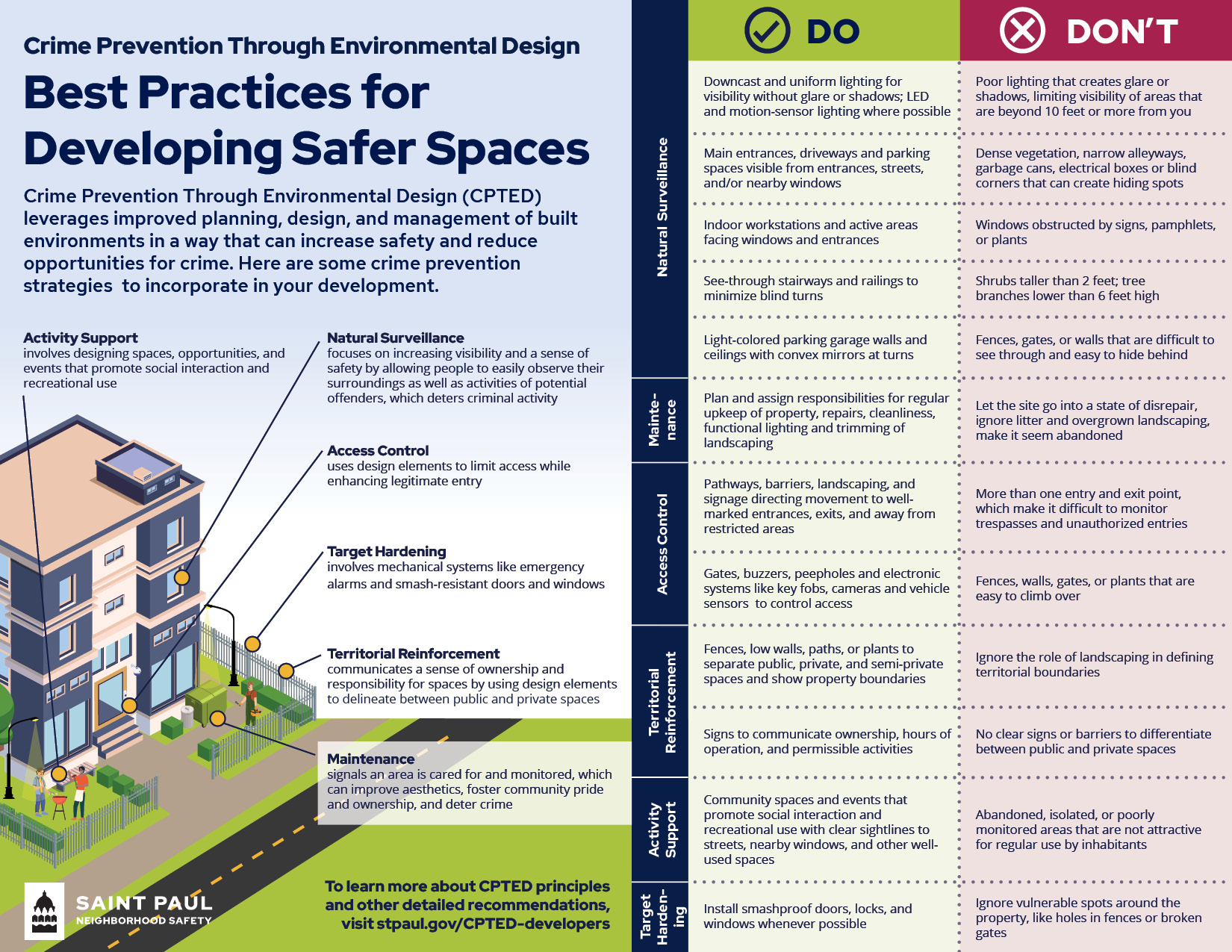
Crime Prevention Through Environmental Design (CPTED) uses improved planning, design, and management of built environments in a way that can increase safety and reduce opportunities for crime on the site.
Last Edited: March 5, 2025
The purpose of the guidelines listed below is to help developers, designers, architects, and homeowners understand how to use Crime Prevention Through Environmental Design (CPTED) to make spaces safer and reduce crime. CPTED focuses on improved planning, design, and management of environments in a way that can increase safety of the site and reduce opportunities for crime. While not all of these recommendations might work for every site, we encourage you to review safety considerations in your neighborhood and use crime prevention strategies in your design wherever possible. They will, however, reduce the probability of crime occurring on your property if properly applied and maintained. Following these guidelines won’t make your property completely “burglary, robbery, or theft proof,” but they can make it less likely that crime will happen if applied and maintained correctly. It is best to adopt these principles in the early stages of the design process.
Please note that city, county, state, and federal govern some of the items mentioned here, and regulations should take precedence over any recommendations made for crime prevention purposes.
Ensure that the lighting on the property is bright enough for people to see clearly, but not too bright to cause glare, dispersion, or shadows that could conceal unwanted activities. People should be able to recognize a face from about 10 meters away.
Use LED lights, as they are cheaper, last a long time, and spread light uniformly. This is especially important along walkways, entrances, exits, and parking lots. For more guidelines related to lighting, you can refer to Illuminating Engineering Society (IES) standards.
Ensure that the main entrance is at least partially visible from the street.
Use motion-sensor lighting wherever possible, especially in areas that are less frequently used.
Ensure that dense plants, narrow alleyways, or placement of garbage cans and electrical boxes do not create hiding spots that are difficult to view from the street or windows.
Ensure that there are clear sightlines and visibility of the site from the streets and windows of nearby buildings, especially in sensitive areas like parking lots and entrances/exits.
Keep windows clear of pamphlets, signs, or plants that could block the view.
Place workstations or active areas (like reception, dining tables, or cashier) near windows that overlook the street and parking lot.
Follow the 2 ft / 6 ft rule for landscaping: keep shrubs no higher than 2 feet and tree branches no lower than 6 feet so that they don’t block views or light.
Make sure driveways and parking spaces are visible from the front/back entrance, streets, and/or windows of the building.
Design stairways so people can see through the stairs and railing to avoid blind turns.
Paint parking garage walls and ceilings light colors and add convex mirrors at turns to help drivers and pedestrians see better.
Use fences, bollards, paving treatments, low walls, or plants to show where the property line begins and to separate public areas from private ones.
Put up signs that show who own the property, when it’s open, permissible activities, and any other important details like the building number, reminders to close garage doors, rules about trespassing, or how to report problematic behaviors on site.
Clearly mark access and exit points so that new visitors can easily find them.
Wherever necessary, create transition zones using paving treatments or landscaping to communicate the difference between public, private, and semi-private spaces.
Use the design of pathways, landscaping, directional signs, etc. to naturally guide people towards entrances and from exits.
Use barriers like fencing, bollards, or thorny bushes to block access to sensitive or restricted areas.
Install gates or electronic systems to control access, like key fobs, automatic doors, and vehicle sensors (for parking garages).
If possible, have only one entry and exit point so that it can be monitored at all times.
Ensure that fencing, walls, and gates are designed to be difficult to climb.
Install cameras, buzzer systems, or peepholes on apartment doors so that residents can see visitors before letting them inside.
Design benches and seating area in a manner that is inviting for short-term use and gathering but discourages long-term loitering.
Assign specific people to take care of regular maintenance, and separate private and community responsibilities as needed.
Create a maintenance plan to keep lights working and landscaping trimmed for better visibility on site.
Set up a system for regular repairs and landscaping to avoid making the place look neglected or abandoned.
Keep landscaping and weeds trimmed and short enough that people can see over and around it.
Provide infrastructure like sports equipment, activity spaces, event rooms, etc. to encourage community activities on site.
Design parks, gathering areas, and seating in places where people can see and be seen from windows, streets, and other busy areas.
Place busy activities in areas that are usually hidden or at-risk of illicit behavior, so that there’s always a flow of people who can keep an eye on those spots. Similarly, locate high-risk sections of the site (eg: ATMs and restrooms) where they are easily visible in areas of high use.
In places where it's hard to naturally watch or control access through design, or where there might be blind spots, use mechanical systems like cameras and emergency alarms.
Make sure doors are at least 1.75 inches thick with strong hinges and locks. Also, put smash-resistant film on windows, especially those on the ground floor.
For retail properties, it is recommended to install alarms that go off if items are stolen, using security tags on products.
All information in the infographic is included on this page in the section above.