“Anchored by deep local roots”
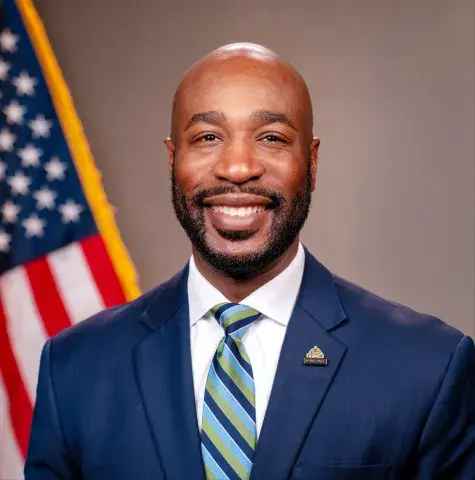
In 2015, Cedrick Baker moved here from Atlanta, sight unseen, to take a job with the Met Council. “I moved to the East Side, where I learned to love all the neighborhood had to offer,” he says. “Saint Paul is the place where I ended up being rooted.”
In classic Saint Paul fashion, Baker’s neighborhood roots inspired him to get involved in the life of the City, both as a volunteer and professionally. He served on the Saint Paul Planning Commission, chaired the former Zoning Committee, and served on Ramsey County’s Parks Commission too.
After four years building partnerships across the breadth of the metro region at the Twin Cities Metropolitan Council, he came back to the City as board administrator and chief of staff for Saint Paul Public Schools. In that work, he says, “I participated in a lot of community groups, which helped me understand the neighborhoods in the City at a personal level.”
Baker’s feeling of belonging to Saint Paul is permanent—as are the regional relationships he cultivated at the Met Council and the civic values that inform his approach to government. These are some of the reasons Mayor Kaohly Her chose him to lead the City’s Office of Neighborhood Safety.
“Cedrick is driven by the fundamental belief that public systems must work for all people to ensure every individual is treated fairly and with dignity,” she wrote on her first day in office. “He combines academic rigor with a deep understanding of the complexity of social systems and a drive to collaborate with others to find solutions. His leadership is further anchored by deep local roots.”
From scrappy startup to core City service
Baker’s rootedness in Saint Paul unites him with the team he now leads at ONS. “I’ve met with everybody on the team to learn about them one-on-one,” he says. “There’s a connection to the work. Most of the team live in our neighborhoods and know the people we serve personally. And everybody is fundamentally committed to keeping Saint Paul residents safe in a way that I haven’t always seen in the public sector. It’s not just talk.”
The City established the Office of Neighborhood Safety by community recommendation in 2022, at the height of the pandemic-era uptick in violence that plagued cities nationwide. From the start, Baker says, ONS had to operate like a startup: “scrappy, moving fast, having to do a lot with a little. This Office has been able to do some amazing work building the plane as they fly it. It is amazing what they accomplished while they were creating the tools and making the connections, in a short amount of time.”
That scrappiness remains a virtue. “What’s worked really well to this point has been quick action to address issues as they arise,” Baker explains. From the start, ONS staff have responded quickly to incidents of gun violence and other sudden disruptions to community safety. “We’re always going to need an element of that. There will always be acute situations to respond to. But now,” he adds, “we need to think about systems and integrating with them, instead of responding ad hoc to emergencies.”
Today, Baker’s goal is to evolve the Office of Neighborhood Safety from startup mode into a core City service, as central and permanent in Saint Paul government as Parks, Police, or Public Works.
Regional challenges, regional partnerships
Achieving that evolution, Baker says, will take collaboration across systems—across City government, among community organizations and institutions, and throughout the metro area.
“The problems that we deal with are not siloed,” Baker says. “A person dealing with unsheltered homelessness can’t stop at municipal borders. Guns can cross the river from Minneapolis. That means we need to partner strategically with other jurisdictions and organizations.”
Baker’s previous work on the Met Council has prepared him to cultivate those regional partnerships. “I don’t have direct authority to tell another jurisdiction what to do,” he says, “so I need to understand what others’ issues are to help us all move in the same direction.”
After Metro Surge, a new understanding of “neighborhood safety”
To Baker, the direction is clear: “Everybody in Saint Paul deserves to be safe and feel safe. Everybody.”
The federal government’s armed occupation of the Twin Cities this year only redoubled his commitment to that fundamental goal. When Baker took the helm at ONS, early this January, Operation Metro Surge had made the work of neighborhood safety newly challenging for the ONS team.
Many of the people ONS serves—neighbors at risk of gun violence or without a safe place to stay—were fearful of being targeted by federal agents. During the surge, Baker says, the ONS team learned that “safety wasn’t just about legality. It was about freedom.” ONS had to pivot to providing services to these neighbors discreetly. “Some families we serve were concerned and scared. They didn’t go to doctor’s appointments. Children weren’t going to school. When they couldn’t go to work, they couldn’t count on food. None of that was safe.”
Making an argument for prevention
As the City prepares to develop a proposed budget for 2027, Baker and his team are building a sustainability plan for the office to continue its impactful work well into the future.
First of all, Baker explains, preventive public safety is just a sound public investment. “We intervene before there is a crisis,” he explains. “When we’re doing our job well, the first responders we partner with can do their jobs more efficiently and better. It's in our best interests, as local government, to align our public safety ecosystem to allow for preventing crisis before they happen and intervene in the cycles of violence and instability some of our residents face through the work of ONS and our partners. We know prevention works. This work allows our emergency response partners to focus on the work they are trained to do.”
Even more important, for Baker, is the value of making our City a place where everyone can stay alive, safe, and free.
“Those who are impacted by community violence and unsheltered homelessness are Saint Paul residents with lives and families. We want to do everything we can to support everyone in Saint Paul. As a City, that’s our duty. It’s the right thing to do,” Baker says. “Have we done all we can? We have not. Let’s roll up our sleeves.”
Related News
2026 ONS Contract Partners: Mid-Year Report
This year, the Office of Neighborhood Safety (ONS) and the Neighborhood Safety Community Council contracted with four to pursue innovative projects to keep Saint Paul safer. Halfway through the contract period, here’s a report on how they’re doing.
Read MoreResearch: “Project PEACE is Delivering”
Over two years, experts from from the Minnesota Justice Research Center worked closely with Project PEACE, Saint Paul’s homegrown gun-violence prevention program, to evaluate the program as it was developing. They released their findings today. Here’s the headline: “The data suggest Project PEACE is delivering. Project PEACE life coaches are keeping people safe, alive, and free—and the clients, families, and community members we spoke with made clear that this work matters.” Here are key findings, recommendations, and a link to the full report.
Read MoreApplications are Now Open for 2027 ONS Neighborhood Safety Partnerships
Every year, the Office of Neighborhood Safety contracts with community organizations to undertake innovative projects to help make Saint Paul safer for all. Applications to work with us in 2027 are open through September 7. We are looking for projects in five key areas: culturally specific violence prevention, support for unhoused neighbors, reducing drug use in City spaces, capacity-building for small organizations, and education for at-risk residents. Find out what we’re looking for and learn how to submit your proposal.
Read MoreThe Data behind Neighborhood Safety in Saint Paul
The heart of our work at the Office of Neighborhood Safety is as low-tech and analog as it gets: Offering someone a meal or a ride to the doctor, a connection to treatment or housing, an encouraging text when life gets hard. But every human interaction generates data we can use to monitor our work in real time and get better at keeping Saint Paul residents alive, safe, and free. Here’s how ONS data analyst Andrew Mua turns human interactions into data—and data into meaning.
Read More