This is the executive summary of the Minnesota Justice Research Center’s 2026 research report on Project PEACE. Learn more about what the research found, and read the full report, at mnjrc.org/peace.


About the Research

“What Does it Look Like to Keep Us Safe, Alive, and Free? An Evaluation of Saint Paul's Project PEACE”

Over the last several years, levels of gun violence have been falling across the country. Yet gun violence remains a public health crisis that impacts communities unevenly across the United States. In Saint Paul, Minnesota, Black residents are 23 times more likely to die from gun homicide than white residents. And in 2024, the city’s gun homicide rate exceeded the national city average.

For decades, the dominant response to this crisis had been reactive and punitive—more policing, more incarceration—and has failed to stop cycles of violence. Community violence interventions (CVIs) and group violence interventions (GVIs) are the two dominant frameworks for addressing gun violence that take a different approach. CVIs are rooted in community-based outreach and credible messenger models and GVIs are centered on focused deterrence in partnership with law enforcement. Efforts to examine the impacts of CVI and GVI approaches abound, but the science of violence prevention is far from settled.

In early 2022, the City of Saint Paul opened their Office of Neighborhood Safety (ONS) as part of the city’s Community-First Public Safety Framework to take a different approach to gun violence. Later that summer, ONS launched Project PEACE (Prevention/Intervention, Environmental Design, Accountability/Outreach, Community Action, and Enforcement), designed as a hybrid GVI/CVI approach to address gun violence at its roots.

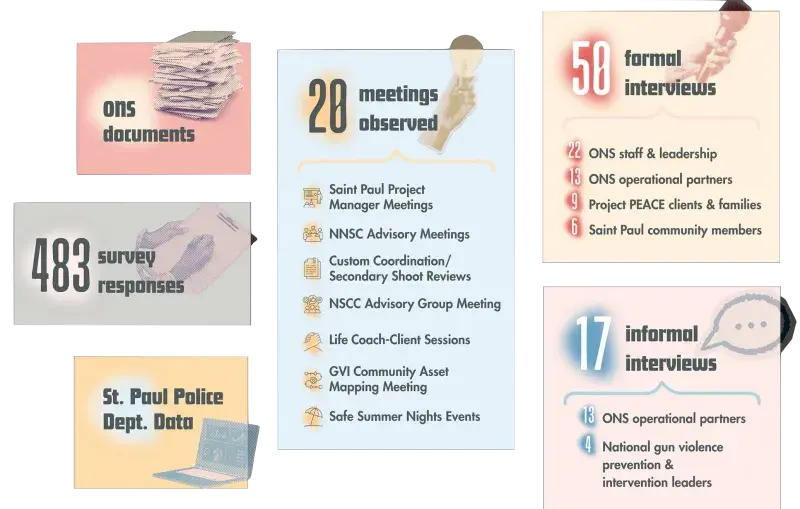
In 2024, ONS contracted with the Minnesota Justice Research Center (MNJRC) to conduct a developmental evaluation of Project PEACE. Our shared goal was to both define and explore the effectiveness of Project PEACE and its impact on gun- and group-violence-involved individuals, their families, and the wider Saint Paul community. Over the course of two years, our evaluation drew on 67 interviews with ONS staff, municipal and community partners, clients and their families, and national gun violence intervention and prevention experts; 20 observations of meetings, community events, and life coach-client sessions; 483 community survey responses; and Saint Paul Police Department data on gun violence from 2021 to 2024.

ONS documents, 483 survey responses, St. Paul Police Dept. data, 20 meetings observed, 50 formal interviews, 17 informal interviews

Key Findings

1

An Ambitious and Promising Approach

Project PEACE represents an ambitious approach—reflecting a mix of CVI and GVI principles—that has expanded and experienced growing pains while laying a promising foundation to address gun violence in Saint Paul. 

ONS launched with a small team facing an enormous mandate, often described by staff as “building the plane as we fly it.” Over four years, it has grown into a multi-tiered office with specialized roles, formalized intake processes, contracted community-based organization (CBO) partnerships, and structured referral pathways despite temporary funding that threatens to undermine what has been built. The program has not been without growing pains—model clarity, staffing, and scope creep have presented ongoing challenges—but the office has demonstrated a genuine capacity to learn and adapt.

2

A Unique and Trusted Bridge

The gun violence intervention and prevention ecosystem in Saint Paul is vast and shifting. ONS’s Project PEACE fills a critical gap as a trusted bridge across partners to prevent, respond to, and address gun violence in ways no other entity can.

Project PEACE staff partner informally and formally with entities across the public sector and in the community from the Ramsey County Attorney’s Office to Saint Paul Parks and Recreation. However, we observed shifts over the two-year evaluation: A strong partnership with the Saint Paul Police Department changed to one that lacked coordination and leaned into competition, while relationships with CBOs began to deepen. Realizing the full potential of this ecosystem will require clearer role definition, a functioning GVI governing board, and partners who understand not just that Project PEACE exists, but what it actually does.  

3

The Vital Work of Life Coaches

Life coaches are the heart of Project PEACE—the most valuable asset and potentially the most vulnerable one. 

PEACE’s life coaches are credible messengers with lived experience in the communities they serve who bring a depth of cultural connection and community trust to the work. Many describe the work as personally healing as well as professionally meaningful. But the emotional weight coupled with the small team size create real sustainability risks.

4

Transforming Lives, Strengthening Communities

The clients of Project PEACE describe their life coaches as transforming their lives and creating ripple effects into their communities. 

The clients of Project PEACE are predominantly young, Black, males. Across the board, clients expressed surprise that their life coaches showed up with urgency, consistency, and genuine care rather than judgment. Life coaches provide concrete wraparound support addressing basic needs like food and housing alongside longer-term goals around employment, education, and legal navigation. Clients credit this support with keeping them out of jail, off dangerous paths, and in some cases, alive. Critically, this impact ripples outward: working with a life coach has changed the way clients show up for their families and communities—and many go on to encourage others in their networks to connect with Project PEACE. 

5

Gun Violence Prevention that Works

Project PEACE staff are operating at the right time, with the right people, in the right space. 

Gun violence decreased in Saint Paul from 2022 to 2024, during the time ONS was building out Project PEACE. This trend mirrors shifts across the country, both in cities with and without CVI initiatives. Data shows who bears the burden of gun violence in Saint Paul: Black residents and young adults aged 18–22 are overrepresented among both those arrested and victimized, mapping directly onto Project PEACE’s target population. Neighborhood-level hot spot analyses point to meaningful local reductions in non-fatal shootings in areas where Project PEACE staff work. Community survey data tells a consistent story: safety matters deeply to nearly all respondents. However, fewer actually feel safe in their neighborhoods and most identify gun violence as a significant problem in Saint Paul. Yet once respondents learned about Project PEACE, strong majorities express support for the model and report feeling safer because of it.

Recommendations

Based on our findings, we offer five recommendations to support Project PEACE’s path to sustainability.

  1. Clarify the model. PEACE is an ambitious acronym covering a vast set of tasks. ONS should get clear on its core framework—and specifically what components of CVI and GVI models they need—and resist pressure to operate as a general social services agency. Clarity internally will also improve communication and expectations with partners.  
  2. Prioritize and strengthen key partnerships. ONS should identify a tiered set of partners—distinguishing core collaborators from peripheral ones—with scoped roles and mutual accountability within each. Whether Project PEACE maintains its hybrid GVI/ CVI approach or shifts emphasis, the partnership strategy needs to follow. A functioning GVI governing board would help provide the shared governance and accountability this ecosystem needs.  
  3. Support and invest in life coaches. Life coaches are doing transformative work and carrying a heavy load. ONS will likely need to hire more life coaches and/or protect their time for client work while prioritizing well-being and professional development. Life coach sustainability is program sustainability.  
  4. Strengthen data collection and impact storytelling. ONS has made progress in formalizing its data practices but more is critically needed. We recommend consistent documentation of the life coaching processes, network-level tracking of violence in Saint Paul, and a commitment to clear storytelling that can communicate impact to funders, partners, and the public.  
  5. Focus on stable and sustained funding. Project PEACE has operated primarily on temporary funding sources. All core staff positions should transition to the general fund, while a mixed funding portfolio—including philanthropic and private sources—could support innovative pilots. ONS should also consider hiring a dedicated grant writer and pursuing policy solutions at the city and state levels to reduce budgetary constraints.

Saint Paul needs Project PEACE and the data suggest Project PEACE is delivering. Project PEACE life coaches are keeping people safe, alive, and free—and the clients, families, and community members we spoke with made clear that this work matters. The program is young, still building its infrastructure, and navigating a challenging political and funding environment. But the foundation is there. With model clarity, sustained investment in life coaches, stronger partnerships, better data, and stable funding, Project PEACE has the potential to become a durable, evidence-based pillar of public safety in Saint Paul.

Learn More and Read the Full Report

More Neighborhood Safety News

Research: “Project PEACE is Delivering”

8/6/2026 Office of Neighborhood Safety

Over two years, experts from from the Minnesota Justice Research Center worked closely with Project PEACE, Saint Paul’s homegrown gun-violence prevention program, to evaluate the program as it was developing. They released their findings today. Here’s the headline: “The data suggest Project PEACE is delivering. Project PEACE life coaches are keeping people safe, alive, and free—and the clients, families, and community members we spoke with made clear that this work matters.” Here are key findings, recommendations, and a link to the full report.

Read More

How One Army Veteran Found a Home in Saint Paul

7/23/2026 Office of Neighborhood Safety

Since the program began in late 2024, the Familiar Faces program has helped more than 50 people get off the streets of Saint Paul to find safe, permanent housing. Every journey from homelessness to home is a hard-won victory for the team and their clients. But their latest success story is special. Meet Randall Todd, a veteran of the U.S. Army mobile infantry, who can see the bridge where he used to sleep from the windows of his new apartment.

Read More

The Data behind Neighborhood Safety in Saint Paul

7/23/2026 Office of Neighborhood Safety

The heart of our work at the Office of Neighborhood Safety is as low-tech and analog as it gets: Offering someone a meal or a ride to the doctor, a connection to treatment or housing, an encouraging text when life gets hard. But every human interaction generates data we can use to monitor our work in real time and get better at keeping Saint Paul residents alive, safe, and free. Here’s how ONS data analyst Andrew Mua turns human interactions into data—and data into meaning.

Read More

Meet Saint Paul’s New Director of Neighborhood Safety

7/15/2026 Office of Neighborhood Safety

Cedrick Baker had spent only four months leading ONS when Mayor Her promoted him to Assistant Mayor for People and Neighborhood Vitality. His successor Toy Vixayvong comes to the job with 25 years of service to the people of Saint Paul and a deep commitment to putting people first. “This community is where my heart is,” says Toy. Learn more about our new director here.

Read More
Learn More about Project PEACE