HREEO Commissions & Committees

The Department, Mayor, and City Council rely on the thoughtful advice of over 30 community boards, commissions, and committees throughout the city. These groups cover a wide range of topics and appeal to a variety of interests.

Applications to city boards, commissions, and committees are accepted on a rolling basis. To find out more about HREEO’s commissions and committees, or to apply online, visit Boards and Commissions, Openings and Application.

HREEO coordinates the following boards and commissions: 

Procurement Division Highlights

The Procurement Division plays a central role in ensuring the City of Saint Paul obtains the goods, services, and construction it needs to serve residents efficiently, transparently, and in alignment with community values. 

Key Procurement Activity in 2025

2024 Procurement Metrics 

Total

New Contracts Executed 

545

Solicitation Events  

131

These contracts supported a wide range of city functions, including public safety, infrastructure, technology, language access, and more. 

Solicitation Methods Used

The City uses different types of solicitations depending on the nature and value of the work:

  • Request for Proposals (RFPs) – 42 events
    Used for services over $175,000 where qualifications and approach
    matter as much as price.
    Examples include translation services, technology consulting, and
    architectural design.
  • Request for Bids (RFBs) – 72 events
    Used for construction, goods, and materials, where lowest price
    wins under state law (Minnesota Statute § 471.345). Examples include
    street reconstruction, playground equipment, and vehicle purchases.
  • Request for Quotes (RFQs) – 9 events
    Used for projects under $175,000, offering a faster process while
    maintaining competitive pricing.
2025 HREEO Buying team with cityscape and river behind them.

Project Start Times

The Procurement Division has an average time between the close of a solicitation and the start of a project:

Solicitation Type 

2024 Avg (Days)

2025 Avg (Days)

Improvement

RFP

74

84

+14% 

RFB

28

40

+43% 

Overall Average

51

62

+22% 

*Increased Project Start times from 2024 to 2025 - can be attributed to Cybersecurity Incident, hiring freeze, etc.

Advancing Local Impact: Common Cent Projects

In 2024, the city launched its first project under the Common Cent
sales tax initiative, investing in streets and parks across Saint Paul.
The Procurement Division ensured that public dollars stayed local
by providing a scoring incentive for City of Saint Paul-based vendors
on Common Cent-funded RFPs which helps support local businesses
and grow community wealth as we build for the future.
CommonCent2024

Contract Compliance & Business Development

Person reviewing and preparing to sign a contract document on a clipboard with a pen, symbolizing business, legal, or professional agreement.

The Contract Compliance and Business Development Division ensures that the community can participate in the economic opportunities created by the City of Saint Paul. Contract Compliance is responsible for several compliance and business development programs:  

  • Affirmative Action and Equal Employment Opportunity
  • Prevailing Wage  
  • Vendor Outreach Program
  • HUD Section 3 

Affirmative Action & Equal Employment Opportunity (AA/EEO)

All vendors with $50,000 or more in city contracts must register their Affirmative Action Plan (AAP) with the
city prior to contract signing. An AAP must include hiring goals for the employment of women, minorities, and
people with disabilities. In 2025:

  • Over 273 vendor Affirmative Action Plans were reviewed and certified.
  • The team reviewed and approved 104 contracts requiring compliance with affirmative action.

Construction contracts receiving city funding must comply with workforce inclusion goals for minorities and women set by the Minnesota Department of Human Rights. Here are the 2025 totals for all construction contracts receiving city funding:

2025 Construction Workforce Inclusion
Minority Inclusion Hours Women Inclusion Hours 
233,964.9542,467.71
Goal  
32% 

Achieved 

20.67% 

Goal  

20% 

Achieved 

3.75% 

Prevailing Wage  

Contract Compliance educates, monitors, and enforces federal, state, and local prevailing wage laws on applicable City of Saint Paul construction projects. In 2025:

  • Contract Compliance monitored labor compliance requirements on over 250 construction projects totaling more than $1.25B in total development costs. 
  • More than 8,000 workers were reported on prevailing wage compliance payrolls totaling more than 1,000,000 construction hours. 
  • Contract Compliance Coordinators also recovered over $14,000 in restitution owed to underpaid individuals working on City of Saint Paul funded construction projects.

Vendor Outreach Program (VOP)

The VOP is the small business inclusion program for CERT-certified, small, woman-owned, and minority-owned business enterprises (S/W/MBEs).  

2025 Local Small Business (VOP) Inclusion 
 

Dollars 

Percentage 

Overall Small Business 

(S/W/MBE) Subcontracting  

$51,209,410 

31.3% 

HUD Section 3

The Housing and Urban Development (HUD) Section 3 program requires that opportunities generated by HUD financial assistance be directed to low-income families and individuals, particularly recipients of public housing and other government assistance. Section 3 also benefits businesses that employ and train local low-income workers.

Section 3 requirements apply to HUD-funded projects involving construction, rehabilitation, or public infrastructure when project assistance meets certain thresholds. 

In 2025, the City of Saint Paul had five projects that met these thresholds. The projects utilized approximately $1.8 million in CDBG funds and $4 million in HOME funds. The total development cost associated with these projects was $58.6 million. 

Across the five projects, 12 Section 3-certified businesses reported qualifying labor hours. In total, 137 contractors, subcontractors, and businesses participated in Section 3-eligible projects.

Breakdown of Section 3 labor hours in 2025

2025Section 3 Worker Hours  Section 3 Targeted Worker Hours  
BENCHMARK

25%

5%

ACHIEVED 

28%

6.5%

In 2025, the City of Saint Paul Section 3 certified:

33 Businesses, 119 Workers, 16 Targeted Section 3 Workers

This year, the City of St. Paul conducted outreach at 5 local and regional events to promote Section 3 contracting opportunities, certification pathways, career and occupational training programs, project fairs and open houses, and other technical assistance resources. These efforts were designed to support both prospective and current Section 3 businesses, workers, and targeted workers. Additionally, the City partnered with the MN Trades Academy / Construction Careers Foundation to strengthen training capacity for local small businesses, including minority-owned, women-owned, and Section 3 businesses. These partnerships also helped expand access to training opportunities for local job seekers, including Section 3 workers and targeted workers.

For more information, visit stpaul.gov/contractcompliance. Individuals can also call 651-266- 8966 or email contractcompliance@ci.stpaul.mn.us. 

Labor Standards Education & Enforcement

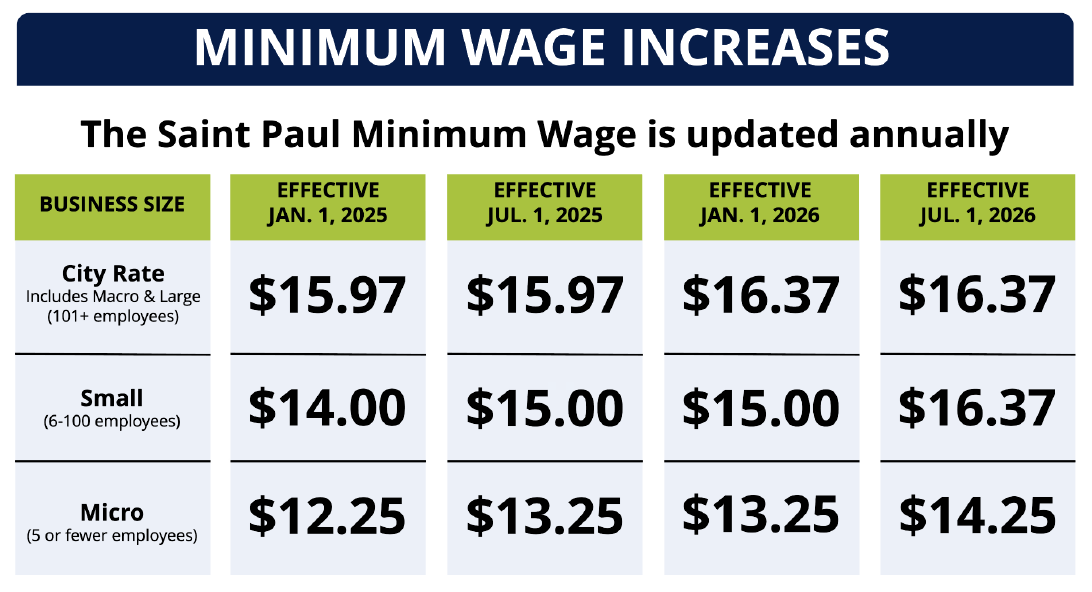
The Labor Standards Enforcement and Education Division is responsible for the education, outreach, and enforcement of the City’s Earned Sick and Safe Time (ESST), Minimum Wage Ordinances and, as of January 1, 2025, the City’s Wage Theft Ordinance. These ordinances apply to employees working within the geographic boundaries of the City, regardless of where the employer is located.  

In addition to enforcing some of the City's labor laws, the Labor Standards team provides free training to employers and educates the community about Ordinances through outreach. The Labor Standards Advisory Committee (LSAC) is made up of 16 community members. LSAC meets monthly to strengthen
community partnerships and engage community stakeholders to support the Division’s strategy development, implementation, and reassessment for strategic enforcement and outreach. In 2025, the Labor Standards Division conducted twelve (12) trainings and presentations, tabled at 21 events, and partnered with the Federal and State Department of Labor to visit Saint Paul businesses during Workplace Rights Week. To stay informed of emerging trends and foster relationships, investigators participated in a two-week intensive nationally held labor standards training, hosted by Rutgers University School of Management and Labor Relations, as well as attended an interactive seminar on the intersection of wage theft and human trafficking hosted by Minnesota Department of Health and the Attorney General's Office.

The Labor Standards Division regularly updates Administrative Rules and supporting materials that are used as resources for employees and employers. For example, the Employee Notice Poster is a tool to educate and inform employees and employers of the City’s labor standards ordinances and is available in five (5) languages.

2025 Labor Standards Case Data Total
Inquiries Received from Employers and Employees 119
Official Complaints Received 45
Closed Investigated Cases36
Employees Impacted in Closed Cases 640
Financial Remedies Ordered $178,49.55
ESST Hours Recovered 2884

Human Rights Investigations (HRI)

The Human Rights Investigation Division enforces the City of Saint Paul Human Rights Ordinance, Chapter 183. 

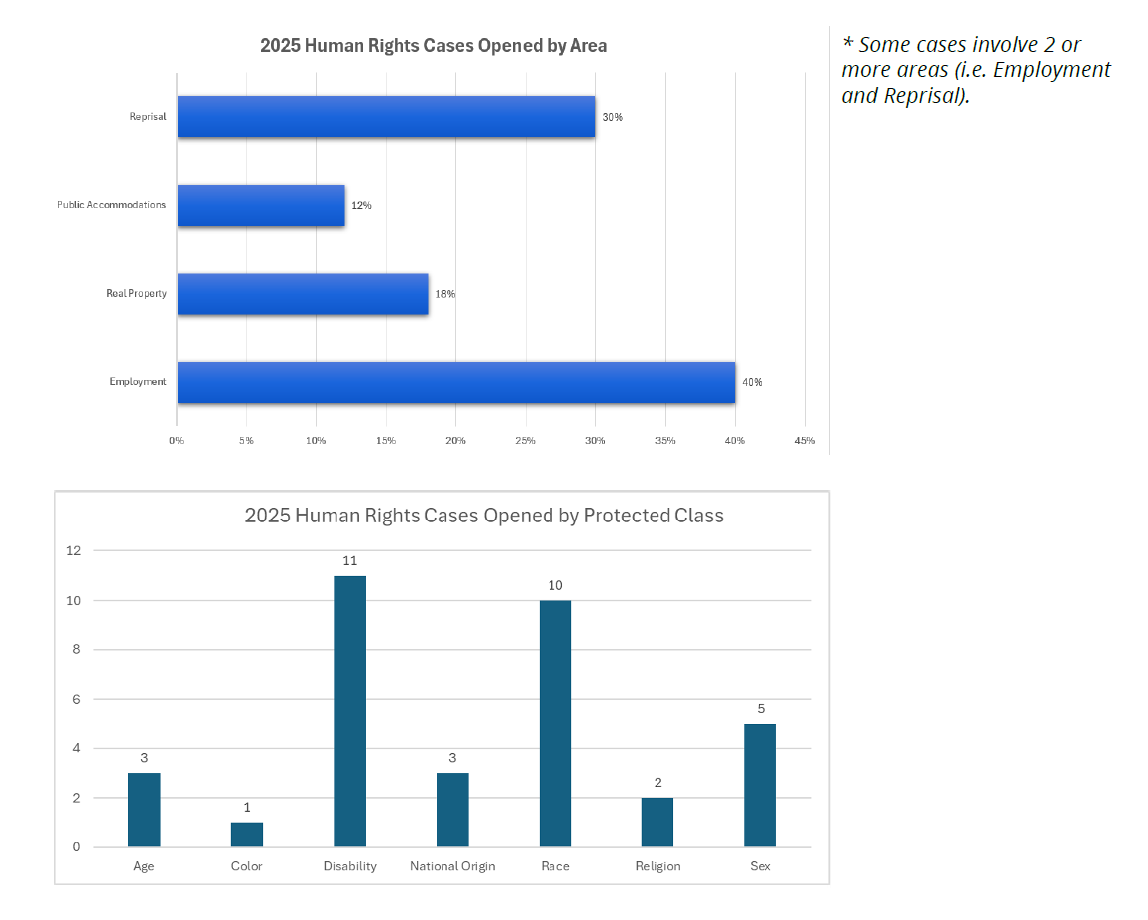
The Human Rights Ordinance prohibits discrimination and harassment based on 13 protected classes: race, color, national origin, disability, sex, gender identity/expression, sexual and affectional orientation, religion, creed, age, marital status, familial status, ancestry, and status with regard to public assistance in the areas of Employment, Real Property (Housing), Education, Public Accommodations, Public Services, Reprisal, Business, and Credit in Saint Paul.

The division investigates alleged acts of discrimination, determines findings of “cause” or “no cause” of discrimination, and mediates settlement discussions before and after investigations conclude. There is no charge for this service.  

Human Rights Cases


 Human Rights Case Outcomes

The Human Rights Investigation division works to settle every case that is opened. The Department offers parties the opportunity to suspend an investigation and work toward a resolution in the matter. This process is referred to as pre-determination settlement conversations that will result in an enforceable agreement that all parties commit to. The Department also works to negotiate conciliation agreements when investigations reveal discrimination or “cause” in a case. Settlement agreements either before or after a determination is made often include some or all of the following things:

  • Policy development and implementation
  • Training
  • Public notice
  • Data collection
  • Restitution
  • Monetary payments. Some examples are:
    • Lost wages
    • Pain and suffering
    • Reimbursement for expenses
Discrimination is Illegal

In 2025, the Human Rights Investigation division negotiated more than $110,000 in direct payments to complainants.

Case Outcomes

No Cause
Cause
Split
PDSA**

25

3

5***

5

 
Transferred to 
another agency
Withdrawn
Administrative 
Closure
Total Cases Closed

2

1

1

42

** Pre-Determination Settlement Agreement (PDSA)
*** Final determination with findings of both cause and no cause.

For more information, visit Human Rights. Individuals can also call 651-266-8966, or email hrightscomplaints@ci.stpaul.mn.us.   
HREEO_NNO_Maryela,Sierra,Sam
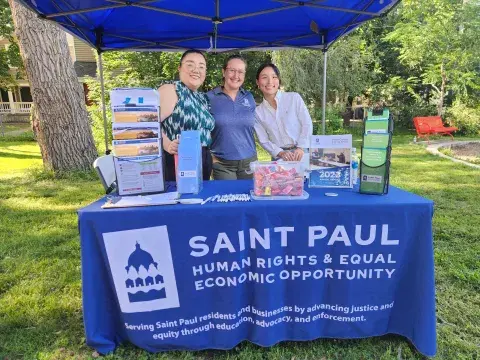
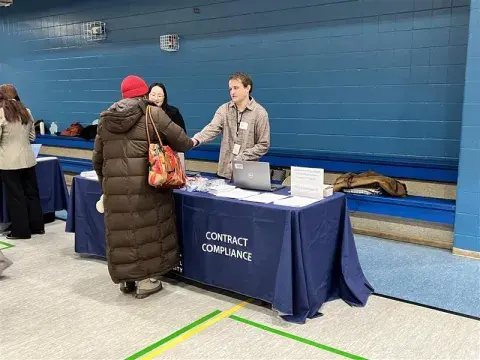
HREEO Staff Tabling at Supplier Fair
Accessibility

Accessibility 

The Accessibility Coordinator enforces Title II of the Americans with Disabilities Act (ADA) and Limited English Proficiency (LEP) services across the city. The Accessibility Coordinator works with city departments to make sure community members do not face barriers to accessing the programs and services the city provides. 

City Departments continued their work on creating, submitting and following up on ADA transition plans to improve accessibility standards in every way each department intersects with the public, whether it in in our physical spaces, services rendered, programs planned, or information disseminated. HREEO has teamed up with the Office of Technology and Communication (OTC) to focus on digital accessibility in the websites, documents and forms that the city controls ahead of new standards put forth by the Web Content Accessibility Guidelines (WCAG2.1). The city will be working with a third-party contractor to make sure all PDFs will be accessible to screen readers and other adaptive technology that people use to access the web. To review the ADA Transition plans, please visit stpaul.gov/adaplans. 

The Mayor’s Advisory Committee for People with Disabilities continues to expand and evolve, with new leadership and bylaws that highlight the committee as a resource and sounding board for the city on all things disability and accessibility related. The Committee continues to provide feedback, advice and the insight of lived experience to departments as they create plans and make decisions that affect the community and the services and programs the city provides.

The City of Saint Paul takes pride in our diverse and
multicultural communities and providing information and
services in any language is essential to create a fully accessible
city. In 2025, we recorded over 30,000 LEP encounters
between community members and city staff. The city
prides itself in making sure anyone looking to access city
services or information is able to communicate and receive
communication in the language of their choice at no cost to
them.
Accessibility ERN

For more information, to request access, or to submit a grievance form, visit stpaul.gov/accessibility. To contact the City of Saint Paul Accessibility Coordinator directly, email adacoordinator@ci.stpaul.mn.us or call 651-266-8966.

Police Civilian Internal Affairs Review Commission (PCIARC)

Composed of Saint Paul residents, the PCIARC is the City’s civilian oversight group or commission that reviews investigations into complaints from community members about misconduct by licensed officers of the Saint Paul Police Department (SPPD). The PCIARC recommends disciplinary actions and policy updates to the Saint Paul Chief of Police based on its review of investigations into complaints filed by community members. The PCIARC does not replace civil or criminal court, rather it makes recommendations to the Chief of Police regarding the conduct of police officers as employees, subject to the Minnesota Peace Officer Discipline Procedures Act (PODPA) and related state labor laws. The Chief of Police has the authority over any discipline assigned to police officers.  

The following table shows cases reviewed by the Commission since the PCIARC moved to HREEO in 2017.
Please note: In 2025, two of the PCIARC case review meetings were canceled due to the City of Saint Paul’s response to a digital security incident.

2017
2018
2019
2020
2021
2022
2023
2024
2025
Cases Reviewed by PCIARC

29

42

44

39

21

19

34

52

30

Total Sworn Officers

54

70

72

81

26

32

66

97

61

Total Allegations

63

77

88

90

26

37

88

124

83

2025 PCIARC Case Review Data

Summary data reflects the 30 cases reviewed by the PCIARC in 2025, as well as disposition and disciplinary recommendations made to the Chief of Police. Please note some of the complaints reviewed by the PCIARC in 2025 were filed in 2024.

PCIARC Commissioners review all case materials, hold case deliberations, and recommend a determination or decision on investigations as to if an officer violated a policy. That determination is called a disposition. Commissioners may also recommend disciplinary action to the Chief of Police and make policy recommendations to SPPD.


To learn more about the PCIARC or file a complaint visit stpaul.gov/pciarc or contact the PCIARC Coordinator at 651-266-8970 or CivilianReview@stpaul.gov

Outreach, Engagement & Communications

The Department’s commitment to communication, outreach, and engagement has remained steady and consistent in 2025. We have continued our efforts as a team to participate in community events, offer presentations, and use communication tools such as the website, email blasts, and social media. 

In 2025, HREEO engaged with a total of 1,817 community members. Staff participated in 51 events and gave 22 presentations.


During 2025, the Public Information Specialist (“Specialist”) supported the establishment of consistent communication methods across both internal and external audiences within HREEO. New processes were also developed to support a clear and efficient flow of communications, improving coordination and information sharing throughout the department and the community. 

One key area of responsibility has been responding to public data requests, with a large focus on managing the significant increase in requests received within HREEO in 2025. The majority of data requests pertain to public procurement data.

Year
Total Data Requests
Closed Requests
Pending Requests
2023

20

18

2

2024

81

76

5

2025

194

187

7

Data was compiled from the City’s Data Practices Center Portal and may not include all requests submitted via email, in person, or by telephone.

Additionally, the Specialist has significantly improved HREEO’s public-facing webpages through a comprehensive website optimization plan to enhance the design and accessibility of HREEO’s online public information. The majority of the optimization plan was finalized at the end of summer 2025, after which HREEO saw an increase in unique website visitors. Here is a look at HREEO’s online traffic presence compared to last years:


Email communications have also continued to evolve, with a strategic shift toward reducing the overall number of email blasts and newsletters in order to improve consistency, clarity, and focus of messaging to community members. Despite sending fewer emails in 2025 compared to 2024, the Department reached a larger number of constituents, demonstrating improved efficiency and engagement in communications. In 2025, email communications reached a total of 272,735 constituents, with an average reach of 5,240 per email and an average delivery rate of 96%.

Year
Total Emails
Total Constituents Reached
Email Average Reach
Average Delivery Rate
2023

08

25,678

3,210

92%

2024

65

223,130

3,486

96%

2025

37

272,735

5,240

96%

The data was compiled from GovDelivery and does not include internal email communications or emails sent directly by City employees to constituents.

On social media, HREEO expanded its presence across the City’s Facebook, X (formerly Twitter), Instagram, and LinkedIn accounts in 2025, with a focused effort on increasing visibility through Citywide channels. Content emphasized community inclusivity and awareness while highlighting HREEO’s services and community offerings. The chart below provides a closer look at HREEO’s monthly social media performance, specifically reach versus engagement.

This chart includes data from the following social media platforms: Facebook, X (formerly Twitter), and Instagram.

Connect With Us

Whether you live, work, or play in Saint Paul, our ordinances hold protections for you. Share your upcoming event and connect with us to arrange a presentation in person or virtually. Staff will inform you about the Saint Paul ordinances that HREEO enforces and will answer your questions about the City’s: 

  • Human Rights ordinance that makes discrimination illegal in Saint Paul 
  • Labor Standards educations such as the Wage Theft, Minimum Wage, and Earned Sick & Safe Time (ESST) Ordinances 
  • Civilian review of police misconduct 
  • Resources for greater language access and better access under the Americans with Disabilities Act (ADA) 
  • CERT program that certifies small and local businesses
  • And so much more! 

Looking ahead to 2026, the Department will focus on strengthening email communications by expanding subscriber growth through enhanced email and web sign-up opportunities, while continuing to prioritize clear, targeted, and high-impact messaging. At the same time, HREEO is committed to deepening community engagement through increased event participation, expanded outreach, and a stronger presence across social media and press. To connect with us, please contact HREEO at Contact-HREEO@stpaul.gov or 651-266-8966. We look forward to working with you!

Download this Report

Prefer a printable version? 

Download the full report as a PDF here. Perfect for sharing or reading offline.

Click here to download & print