Visual Speed Limit Monitoring

Dynamic digital speed limit signs, which show vehicle speeds in real time, are used on arterial (main) streets. Arterial streets are signed at 25 mph or higher.

Public Works has 8 temporary digital speed limit signs, which are moved around the City to help calm traffic. Generally the digital signs are in one location for about 4 weeks.

To request a temporary digital speed limit sign for a specific arterial (main) street, please email Traffic Engineering at PW-trafficgeometrics@ci.stpaul.mn.us with the desired location, including the name of the arterial street and the cross street. Eligible streets will be added to the list of locations for digital speed limit signs in the order that they are received. Note that not all streets are eligible for a digital speed limit sign.
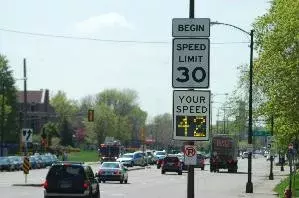
Speed limit sign

Bump Outs

Bump outs are curb extensions that extend the sidewalk into the parking lane to narrow the roadway. Bump outs enhance pedestrian safety by increasing pedestrian visibility, shortening the crossing distance, slowing turning vehicles, and visually narrowing the roadway to help slow vehicle traffic.

Traffic calming features such as bump outs and pedestrian refuges are generally installed as part of larger street improvement projects on arterial streets but may also be considered to address specific safety problems on a case-by-case basis.
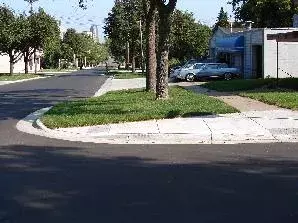
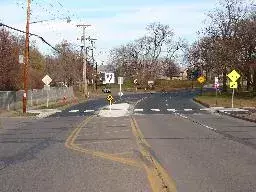
Bump out in a residential neighborhood

Pedestrian Refuges

Pedestrian refuges (pedestrian islands) are small sections of pavement surrounded by roadway where pedestrians can stop midway through crossing the street. Pedestrian refuges shorten the distance a person needs to walk in order to cross a street and allow for crossing the street in two segments. They are generally used on multi-lane streets where traffic speeds and volumes make pedestrian crossings more difficult.

Traffic calming features such as pedestrian refuges are generally installed on arterial streets as part of larger street improvement projects but may also be considered to address specific safety problems on a case-by-case basis.
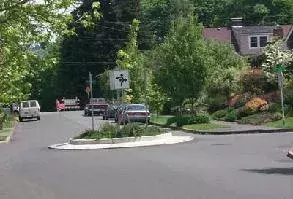
Pedestrian refuge in the middle of a street as part of a crosswalk
 

Traffic Circles

Traffic circles are used on low volume streets in Saint Paul neighborhoods to slow traffic speeds and often replace stop signs at four-way intersections. They are also used on bike boulevards to help make bike crossings of intersections easier.

Traffic circles are usually implemented as part of larger construction projects or in conjunction with the addition of bike boulevards.

Traffic circle in a residential neighborhood

Pedestrian Centerline Signs

Pedestrian centerline signs are temporarily placed within the roadway on the centerline or between lanes of traffic to remind drivers to stop for pedestrians at busy intersections without stop signs or traffic lights. These signs are generally used on arterial (main) streets.

Public Works rotates the locations of these temporary signs throughout the year.

To request a temporary pedestrian centerline sign for a specific arterial (main) street, please email Traffic Engineering at PW-trafficgeometrics@ci.stpaul.mn.us with the desired location, including the name of the arterial street and the cross street. Eligible streets will be added to the list of locations for pedestrian centerline signs in the order that they are received. Note that not all streets are eligible for pedestrian centerline signs.

Other Traffic Techniques

Public Works uses other traffic techniques throughout Saint Paul.

Crosswalks
Pedestrians can cross streets anywhere there are pedestrian ramps on both sides of the street. Drivers must stop for pedestrians in a crosswalk, whether it is painted or not.

Crosswalks are painted at some locations. A painted crosswalk must have a minimum average of 20 pedestrian crossings per hour and pedestrian ramps and sidewalk on both sides of the street.

Stop Signs
Stop signs are strategically placed to create a citywide "basket-weave" design (every other intersection) to calm traffic on residential streets. Four-way stop signs are used at intersections with higher traffic volumes.

Bollards
Bollards are short posts used to create a visual perimeter and mark boundaries. Saint Paul uses bollards to designate protected bike lanes, pedestrian islands and bump outs for crosswalks.

Speed Limit Signs
Speed limit signs are placed at specific intervals on arterial streets. Speed limit signs are not posted on residential streets (20 mph). Citywide gateway speed limit signs are posted at all entrances to Saint Paul, stating "Citywide speed limit 20 mph unless otherwise posted."

Pedestrian Signals
Pedestrian signals are installed at intersections with traffic signals. Some pedestrian crossings on high volume arterial streets have standalone pedestrian signals, such as flashing LED or HAWK signals.